VR Laser Synth
Expressive VR Performance Instrument
Overview
Modern sound synthesis offers infinite sonic possibilities, yet digital instruments often lack the physical expressiveness of their acoustic counterparts. The Laser Synth is a Virtual Reality (VR) instrument developed as my Bachelor's capstone project and presented at the ICSC 2024 Csound Conference.
Unlike VR installations that rely on generative randomness, the Laser Synth is designed for intentional, traditional performance. Through spatial tracking, it creates an interactable interface that bridges human movement with the infinite possibilities of digital audio in a live performance context.
Instrument Control & Design
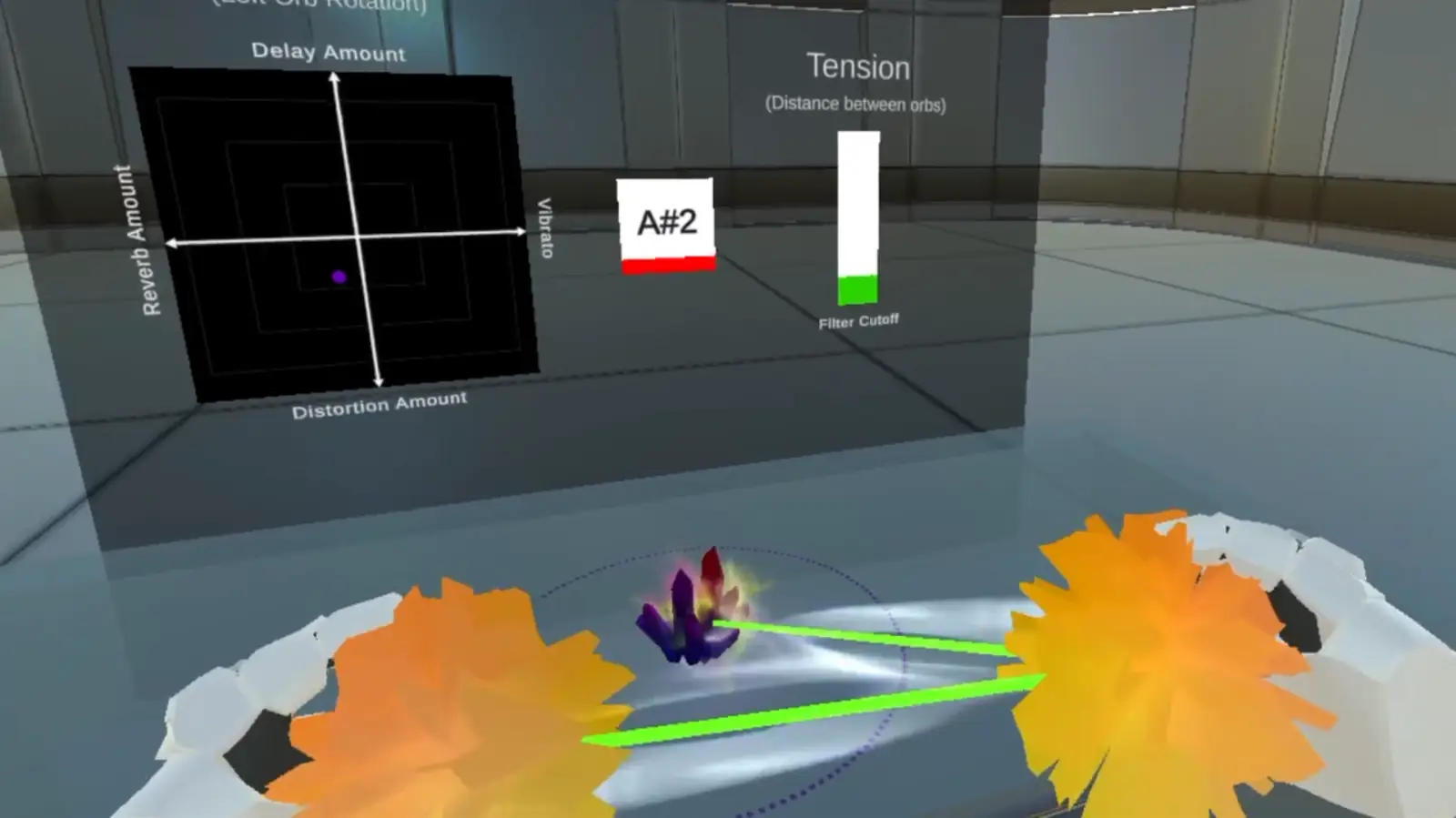
The instrument architecture revolves around three objects: a stationary central crystal and two hand-held orbs. The lasers which connect these objects represent the geometric relationship that drives the synthesis engine.
Pitch & Filter:
The distance between the Crystal and right orb controls pitch (quantized to 12-TET), while the distance between the Two Orbs modulates the filter cutoff frequency.
XY-Pad Rotation:
The left orb rotation functions as a 3D XY-pad, allowing for simultaneous manipulation of parameters like vibrato, reverb, and distortion.
Technical Implementation
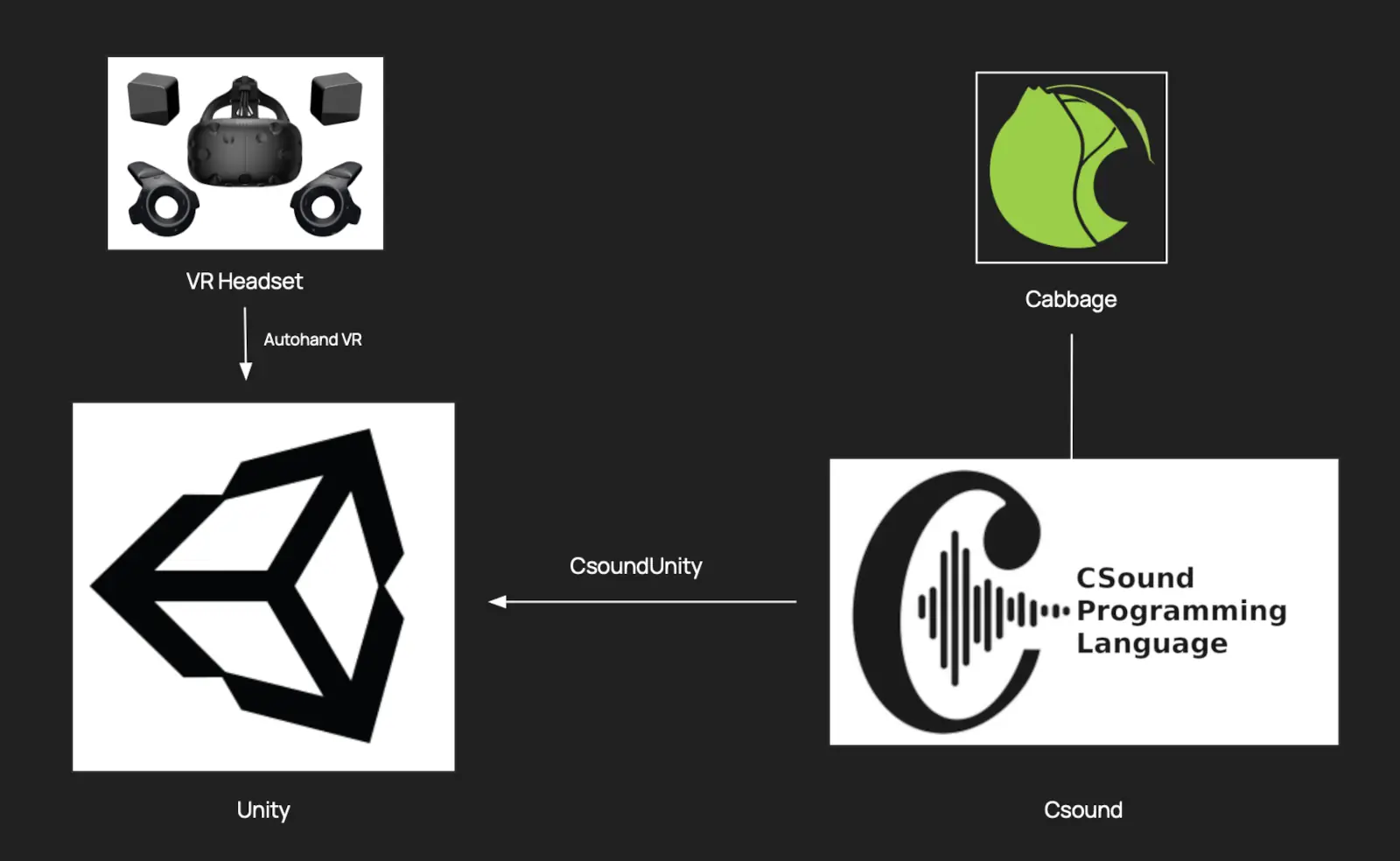
The Laser Synth leverages the CsoundUnity package to run Csound within Unity. This decoupling allows Unity to focus on spatial logic and visual feedback while Csound handles precise sound synthesis.
The Csound code was prototyped in Cabbage, and tactile VR interactions were implemented using the Auto Hand VR physics system.
Key Outcomes
Natural Interaction
Proved that spatial distances in VR provide more intuitive 'theremin-like' control than traditional knobs and sliders.
Visual Reinforcement
Developed a HUD including a 3D chromatic tuner and dynamic laser color-coding for informative live performance feedback.
Academic Recognition
Successfully presented at the International Csound Conference (ICSC) 2024, highlighting the intersection of VR and professional-grade synthesis.
Challenges & Solutions
Problem 3D Pitch Accuracy
Performing melodies in invisible 3D space is difficult without haptic feedback or 'frets' to guide the hand.
Solution:
Implemented a 12-tone equal temperament quantization engine within the pipeline to provide a margin of error for the performer.
Problem Sound Design Testing
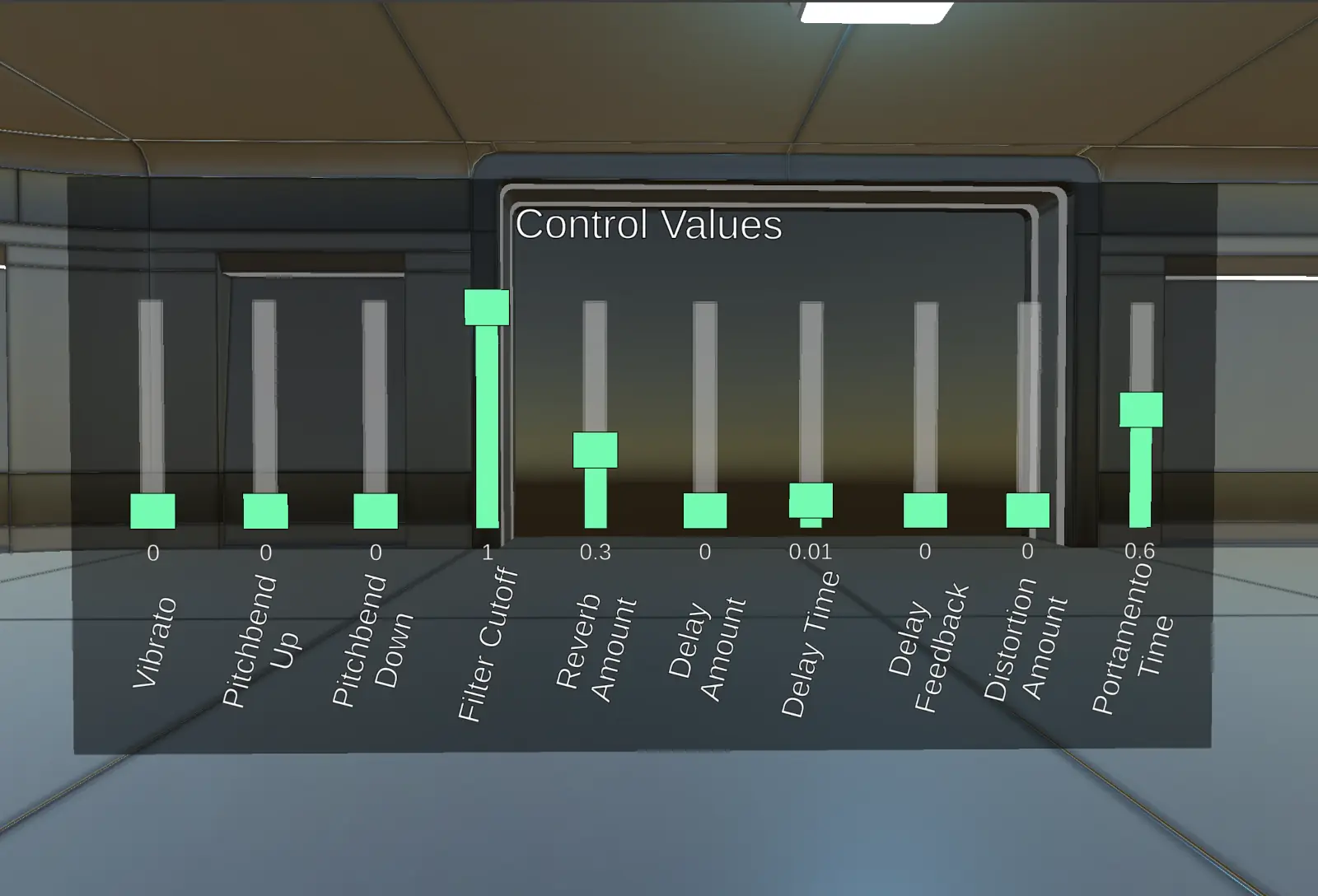
Iterating on Csound code required constant removal of the VR headset, which was cumbersome during development.
Solution:
Introduced in-VR dropdowns and sliders to adjust 10 key synthesis parameters in real-time without leaving the environment.
Future Work
Scalable Polyphony
Transitioning from monophonic to polyphonic synthesis by manifesting multiple resonant crystals as independent audio voices.
Expanded Preset Architecture
Creating a comprehensive preset ecosystem to provide high-quality 'out-of-the-box' configurations and allow performers to toggle between user created states.