PiSynth: Polyphonic Physical Modeling Synthesizer for Embedded Linux
8-Voice Karplus-Strong Synthesizer on Raspberry Pi 5
Overview
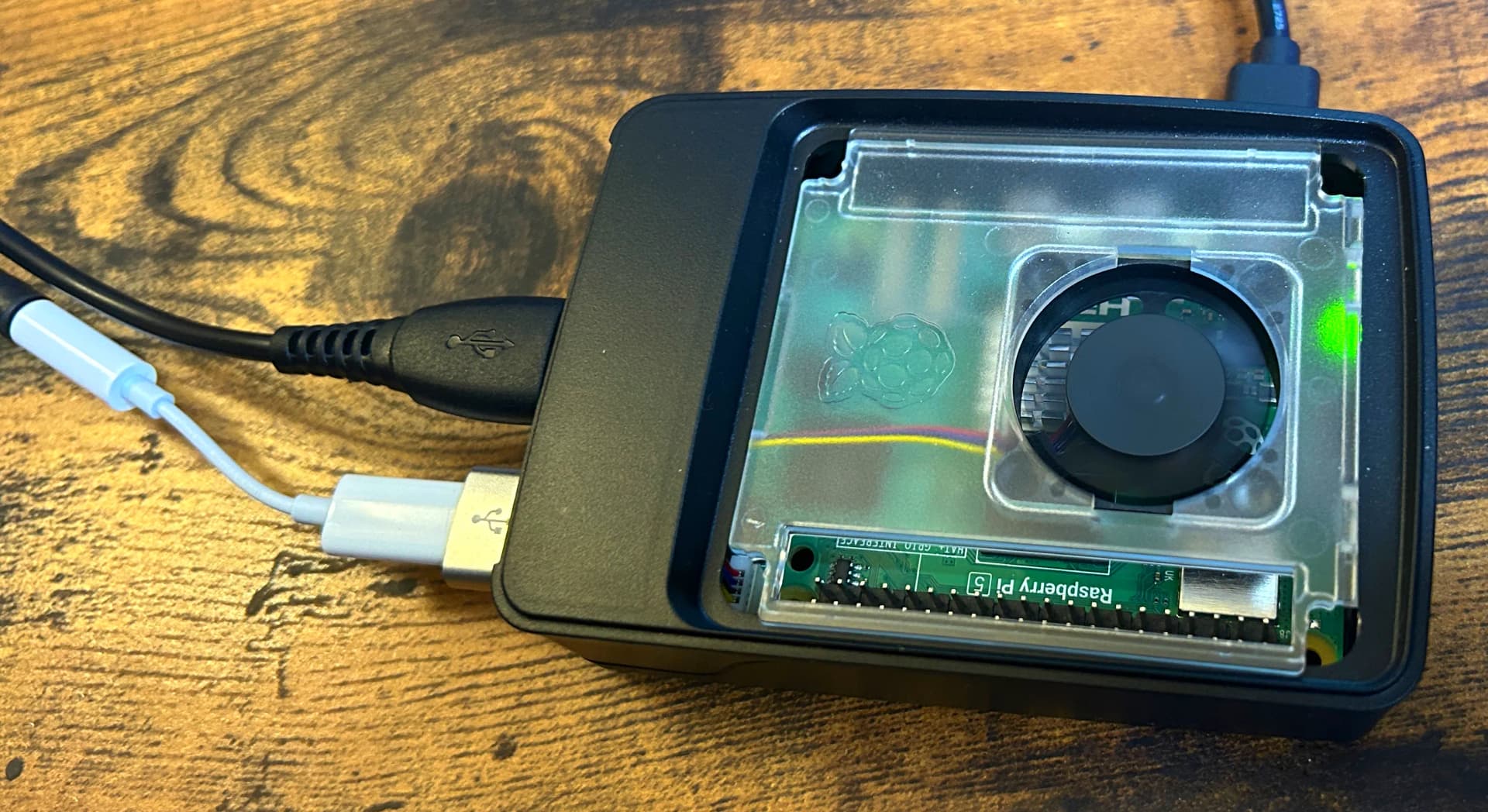
The design goal was a music appliance: plug in a USB audio interface and MIDI keyboard, power on, and the synth is ready to play from any browser on the local network with no terminal, no configuration, no logged-in user.
The result is an 8-voice Karplus-Strong physical modeling synthesizer on a Raspberry Pi 5, deployed as a systemd service with real-time thread scheduling achieved without running as root. Round-trip latency is deterministically held to sub-11 ms.
Architecture
The Appliance Constraint
Every architectural decision in this project traces back to a single product constraint: building a headless music appliance on a general-purpose OS. The user must be able to plug in their hardware and play immediately, with no display, no terminal, and no configuration.
| Constraint | Engineering Solution |
|---|---|
| No user session or terminal | Deployed as a headless systemd service, relying on file capabilities to acquire rootless real-time scheduling on boot. |
| Bring-your-own-hardware | Runtime device discovery, auto-connecting MIDI, and adaptive formatting (float vs. TPDF dithered 16-bit). |
| No onboard display | A uWebSockets server hosting a live browser UI, accessible from any device on the local network. |
| Flawless audio playback | A dedicated SCHED_FIFO audio thread isolated from the OS and UI via a lock-free ring buffer. |
Incremental Repository Structure (9 Chapters)
The repository is structured as nine self-contained, buildable milestones:
| Chapter | Milestone |
|---|---|
| 1 | Raw ALSA PCM sine wave output |
| 2 | USB MIDI input & note mapping |
| 3 | Simple Synth: MIDI-to-audio bridge, basic voice engine |
| 4 | Poly MIDI Synth: 8-voice polyphony, thread safety, lock-free ring buffer |
| 5 | Pluck Synth: Karplus-Strong physical model, ADSR, parameter smoothing |
| 6 | CC Control: full MIDI CC parameter mapping at runtime |
| 7 | Effects Bus: ZDF SVF, Freeverb, chorus, ping-pong delay |
| 8 | uWebSockets real-time browser UI & spectrum analyzer |
| 9 | systemd deployment & Linux capabilities (headless, rootless) |
Core Audio Architecture & OS Interaction
The Real-Time Mental Model
The primary bottleneck in Embedded Linux audio is not DSP computation; it is the kernel scheduler. On a general-purpose OS, any thread can be preempted at any time, causing the audio callback to miss its deadline and produce a dropout.
The solution is isolation: the audio loop runs on a dedicated thread at SCHED_FIFO priority 80. This places it above nearly all other system activity. The thread never blocks, never allocates, and never touches shared peripherals. All parameter changes arrive through a lock-free ring buffer.
Adaptive Output Formatting & TPDF Dithering
Rather than routing through PulseAudio or JACK, the engine writes directly to the ALSA PCM buffer. At startup, it probes hardware capabilities and selects the best available format: 32-bit or 24-bit float output is used natively when supported, avoiding any quantization step.
For 16-bit fallback devices, TPDF dithering (triangular probability density function) is applied prior to truncation. TPDF adds triangular noise that decorrelates quantization error from the audio signal, trading harmonic distortion for a mathematically flat, benign noise floor.
Measured Round-Trip Latency
Measured via physical hardware loopback and arecord (accounting for initialization offsets), the system achieves a consistent ~8–11 ms round-trip latency.
| Stage | Latency |
|---|---|
| MIDI poll wake | ~1 ms |
| ALSA output buffer (4 periods × 64 samples @ 48 kHz) | 5.33 ms (deterministic floor) |
| USB audio frame + DAC → cable → ADC | ~1–2 ms |
| Scheduler jitter & USB hub overhead | ~1–4 ms (uncontrollable OS/USB variance) |
| Total round-trip | ~8–11 ms |
The 5.33 ms ALSA buffer is an exact, hardware-dictated floor. The variance in total latency (8 vs. 11 ms) is entirely attributable to scheduler jitter and USB transfer timing, neither reducible in software without hardware changes.
DSP Implementation & CPU Profiling
Extended Karplus-Strong Engine
The synthesis model goes beyond a basic feedback delay line in two key places:
-
Pluck Position (Excitation shaping): Initial string excitation uses a variable-width triangle pulse rather than a burst of white noise. The pulse width controls pluck position: a narrow pulse centered at the bridge excites more high-frequency partials; a wider pulse toward the middle produces a warmer, more fundamental-heavy attack. This directly models the physics of where a plectrum contacts a string.
-
Pickup Position (Harmonic comb filter): A waveguide-inspired comb filter is applied to the output, parameterized by a normalized position along the string. This mimics the behavior of a physical pickup: a pickup at a pressure node of a given harmonic will null that harmonic from the output. The result is a timbral character shift that tracks the harmonic series of each note.
Tuning-Compensated Feedback Gain
Naive Karplus-Strong implementations use a fixed feedback gain just below 1.0. This causes decay time to vary with pitch: lower notes decay faster than higher ones because the delay line is longer, meaning the gain is applied fewer times per unit time at lower frequencies.
The engine calculates a frequency-aware feedback multiplier that normalizes decay time across the full MIDI range, guaranteeing consistent sustain character regardless of which octave is played.
Voice ADSR Architecture
| Feature | Detail |
|---|---|
| Attack & Release timing | Sample-accurate; no scheduler-tick rounding |
| Kill ramp | Dedicated fade-to-silence ramp for clean voice stealing |
| MIDI CC mapping | All ADSR parameters addressable via MIDI CC at runtime |
| Gate behavior | Note-off triggers release phase; voice holds until envelope floor |
Parameter Smoothing
Every continuously-variable parameter in the engine (filter cutoff, resonance, pluck position, pickup position, effect sends) runs through one-pole IIR smoothing on the audio thread. This eliminates zipper noise, the audible stepping artifact produced when parameter values jump discretely between audio blocks during live input or CC modulation.
Master Bus: ZDF SVF, Chorus, Delay, Reverb
Mixed voices route through a Zero-Delay Feedback (ZDF) state variable filter. A naive SVF introduces a one-sample delay in the feedback path, which warps the frequency response at high cutoffs. The ZDF formulation uses a trapezoidal integrator to solve the feedback loop algebraically per sample, eliminating the unit delay entirely and preserving analog-accurate phase behavior up to Nyquist.
The master bus also includes stereo chorus, ping-pong delay, and Freeverb reverb, all running after the SVF.
Real-Time Spectrum Analyzer
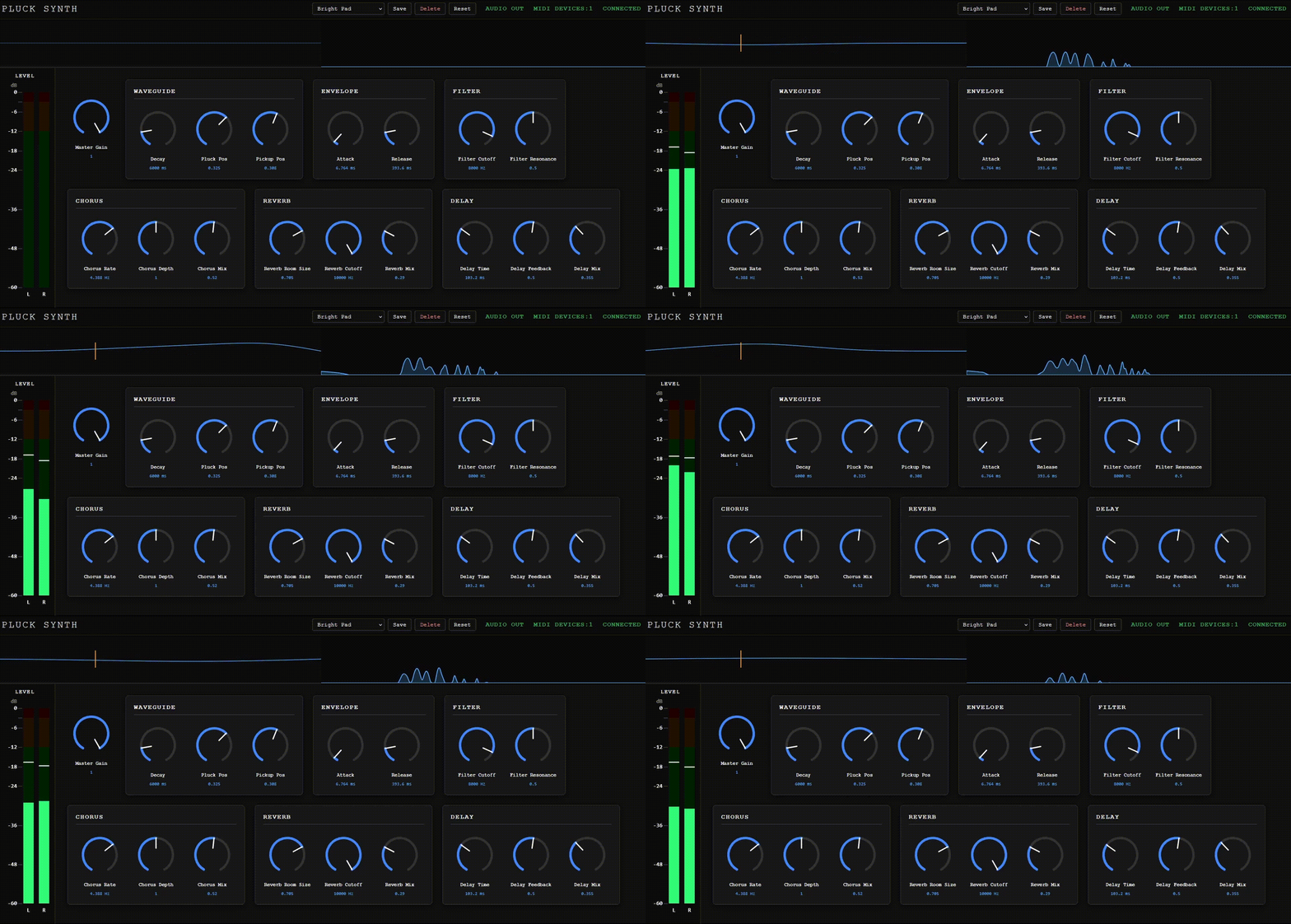
The WebSocket-driven spectrum analyzer applies a Blackman-Harris window before the FFT. Blackman-Harris was specifically chosen for its −92 dB sidelobe suppression, the best sidelobe rejection of common windows at the cost of a wider main lobe. For a musical instrument visualizer, spectral leakage masking narrow peaks is the dominant concern, making this the correct tradeoff over a Hann or Hamming window.
CPU Utilization
Measured at 48 kHz, 64-sample period on Raspberry Pi 5:
| Condition | CPU Load (1 of 4 Cores) | Notes |
|---|---|---|
| Idle (engine running, 0 voices) | 16.2% | ALSA loop, WebSocket, MIDI poll overhead |
| 8 voices, dry (no effects) | 23.9% | +7.7% over idle |
| 8 voices, all effects enabled | 23.9% | Sub-1% incremental cost for master bus |
The profiling result is the key insight: the waveguide feedback loop is the cost center (+7.7% over idle). The entire master bus effects chain (SVF, chorus, delay, reverb) adds less than 1% on top of that. Optimization effort must be focused on polyphony and the delay line, not effects processing.
Concurrency & the Non-Blocking Audio Thread
The Challenge
Three threads compete for the audio engine's parameter state: the high-priority audio thread (SCHED_FIFO), the WebSocket UI thread, and the MIDI polling thread. The audio thread cannot take locks. Calling pthread_mutex_lock can block the thread, and a blocked audio thread guarantees dropped frames.
Multi-Core ARM Memory Semantics
The solution is a lock-free SPSC (Single-Producer/Single-Consumer) ring buffer using std::atomic. On a single-core microcontroller, using default sequential consistency (seq_cst) is a safe, albeit conservative, approach. However, scaling up to the Raspberry Pi 5's multi-core SMP (Symmetric Multiprocessing) architecture introduces the strict reality of ARM's weak memory model. Across multiple cores, the processor and compiler are free to reorder loads and stores. A producer writing data to a shared buffer and updating an index does not guarantee the consumer will see the data write before the index update unless memory barriers are precisely defined.
The Solution: Explicit Release/Acquire Semantics
To enforce correctness without the unnecessary overhead of default seq_cst barriers, the ring buffer implements explicit C++ atomics with tailored acquire/release semantics:
// Producer (WebSocket / MIDI thread)
bool push(const T &item) {
    size_t write = write_pos.load(std::memory_order_relaxed);
    size_t next  = (write + 1) % CAPACITY;

    if (next == read_pos.load(std::memory_order_acquire)) return false; // full

    data[write] = item;

    // publish the write: must happen after data is written
    write_pos.store(next, std::memory_order_release);
    return true;
}

// Consumer (audio thread)
std::optional<T> pop() {
    size_t read = read_pos.load(std::memory_order_relaxed);

    if (read == write_pos.load(std::memory_order_acquire)) return std::nullopt; // empty

    T item = data[read];

    // publish the read: must happen after data is copied
    read_pos.store((read + 1) % CAPACITY, std::memory_order_release);
    return item;
}
Three ordering decisions work together here. First, each side loads its own index with relaxed, safe because in a SPSC queue only one thread ever writes each index, so there is no cross-thread race on that load. Second, the core happens-before pair: write_pos.store(release) in push guarantees the data write is visible to any thread that subsequently sees that store via write_pos.load(acquire) in pop. Third, the relationship is symmetric: read_pos.store(release) in pop publishes the consumer's progress back to the producer, ensuring the full-check in push sees an up-to-date slot count before reclaiming capacity. This is the minimal correct set of barriers for SPSC on multi-core ARM, validated by stress-testing under high thread contention directly on the Pi 5 hardware.
Testing & Validation
Problem Filter Response Correctness
Validating that the ZDF SVF and any biquad stages behave mathematically correctly
Solution:
Automated tests assert at least −36 dB of rejection one decade above the cutoff frequency, confirming rolloff characteristics consistent with the expected −40 dB/decade slope without over-constraining implementation variance.
Problem ADSR Timing Accuracy
Envelope timing errors accumulate across voices, causing inconsistent dynamics that are audible but difficult to attribute to a specific bug.
Solution:
Tests assert exact sample counts for each ADSR stage transition and verify release convergence to exact zero, not asymptotic fade. No scheduler-tick rounding is tolerated.
Problem Parameter Smoothing Convergence
One-pole IIR smoothers must converge predictably. An incorrect time constant means either audible zipper noise (too slow) or sluggish parameter response (too fast).
Solution:
Tests confirm 63% convergence after exactly one time constant (the mathematical definition of a first-order system) and predictable tail termination, validating the coefficient calculation directly.
Problem Pitch Detection Accuracy
Autocorrelation-based pitch detection operates in discrete frequency space. Peak-picking on integer lag indices introduces a systematic bias that causes detected pitch to deviate from true pitch.
Solution:
Applied parabolic interpolation to the autocorrelation peak, fitting a parabola to the peak and its neighbors to find the sub-sample true maximum. Tests confirm pitch accuracy to ±2 cents across the MIDI note range.
Problem ARM Memory Model Validation
The lock-free ring buffer's correctness under the ARM weak memory model cannot be proven by analysis on x86 hardware or by reading the C++ standard alone.
Solution:
The ring buffer was subjected to concurrent stress-tests executed directly on the Raspberry Pi 5 under high thread contention, validating that no data races or torn reads occur on the target architecture under real scheduler conditions.
Reflection
This project is a direct evolution of my previous bare-metal STM32 synthesizer, and the appliance constraint is what drove every decision that differs between them. The non-blocking audio loop, the SCHED_FIFO isolation, and the WebSocket UI all exist so the user can plug in and play without ever touching a terminal, while protecting the audio thread from kernel preemption.
The progression of the audio engine's concurrency model was particularly clarifying. In the STM32 project, I implemented the lock-free buffer using std::atomic with default sequential consistency, a conservative and safe choice given the single-core Cortex-M4 target. Porting to the quad-core SMP architecture of the Pi 5 raised the stakes: what was safe-by-default on a microcontroller became a strict correctness requirement on multi-core ARM. Refining the memory ordering to use explicit acquire/release semantics was the direct follow-through on the gap I identified in the STM32 project. Profiling the engine revealed that the mathematically dense SVF and master effects bus cost less than 1% of CPU overhead, proving that in physical modeling, the waveguide feedback loop is the true computational bottleneck.
Future Work
NEON SIMD Vectorization
The delay-line reads and writes across 8 voices are embarrassingly parallel. ARM NEON intrinsics could process multiple voices in lockstep, theoretically doubling polyphony within the same CPU budget.
I2S Audio Output
Replacing the USB audio interface with an I2S DAC (e.g., HiFiBerry DAC+) would eliminate USB transfer jitter entirely, pushing round-trip latency below 3 ms, shattering the current floor set by USB overhead.
MPE (MIDI Polyphonic Expression)
MPE would enable per-note continuous control data (pressure, slide) to dynamically modulate pluck position, pickup position, and pitch bend on individual strings simultaneously, making the physical model fully expressive.